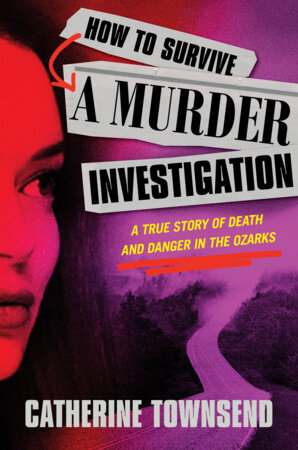
A true story of death and danger in the Ozarks.
Catherine Townsend is a journalist, private investigator, and podcaster. Her work has appeared in publications including The Atlantic, Elle, New York, GQ, Marie Claire, Cosmopolitan, the Daily Mail, the New York Post, Cosmopolitan and The Huffington Post.
But her greatest passion has always been solving mysteries. So in 2010 she channeled her inner Nancy Drew and signed up for detective school, where she was immediately thrown into the field with former FBI agents, police officers and other PIs. Over the next three years Catherine completed well over the 6000 hours required to become a licensed private investigator in California.
When I read the description of Catherine Townsend’s true crime book, How to Survive a Murder Investigation, I was desperate to dive in. There’s just something so captivating about an unsolved murder case, and a ‘behind the scenes look’ that hooks me. And considering it happened so close to her hometown, in the Ozarks, it gave her voice more authority and I was excited to learn her findings on the case.
Her voice was compelling, and she did an amazing job at examining the various theories surrounding Rebekah Gould’s murder, including all the suspects in the case and the frustrations felt by the local police. Surprisingly, I also really enjoyed the unrelated murder cases that were inserted along the way, keeping my interests piqued, instead of letting the pace drag. The fact that Townsend thinks the real killer was never caught by police felt more in line with reality considering the lack of resources remote police departments have in small towns. Nothing ever aligns like we read in fiction. I would have liked to learn more details about Rebekah Gould and Billy, the man charged with her murder.
Synopsis:
What does it really take to solve a murder . . . and come out alive?
In 2004, Catherine Townsend was working as a journalist in London when college student Rebekah Gould vanished near Townsend’s childhood Ozarks retreat. Rebekah’s body was found a week later, leaving behind a blood-soaked trailer, a devastated family, and rumors that refused to die. To local police, Rebekah was just another “high-risk victim” who dated a lot of men and made a lot of women jealous. As time passed, the investigation stalled.
Thirteen years later, Townsend left her home base in New York for Arkansas, determined to crack the cold case, force the police to finally pay attention, and reckon with the place that had made her. In the process, she discovered that the truth about cold case investigations is a long way from what we see on TV—and that the roles people play in a murder case are rarely as simple as they seem.
As an investigative journalist, Townsend has faced danger from the potential murder suspects she’s trying to hunt down—and resistance from police who tell her that “investigations are grownup stuff” and to mind her own business. With How to Survive a Murder Investigation, she calls them all out as she recounts the audacious true story of her relentless search for the truth.


Leave a Reply